


ENLIGHT 2100 – HIGH-END EIT MONITOR


High-end EIT (Electrical Impedance Tomography) Monitor system
Model: ENLIGHT 2100
Brand: Timpel Medical / Brazil
Manufactured: Brazil
Certificates: ISO, CE
- Description
Description
General information
Lung’s Electrical Impedance Tomography (EIT) monitor
Model: ENLIGHT 2100
Brand: Timpel SA – Brazil
Manufactured: Brazil
Certificate: ISO, CE
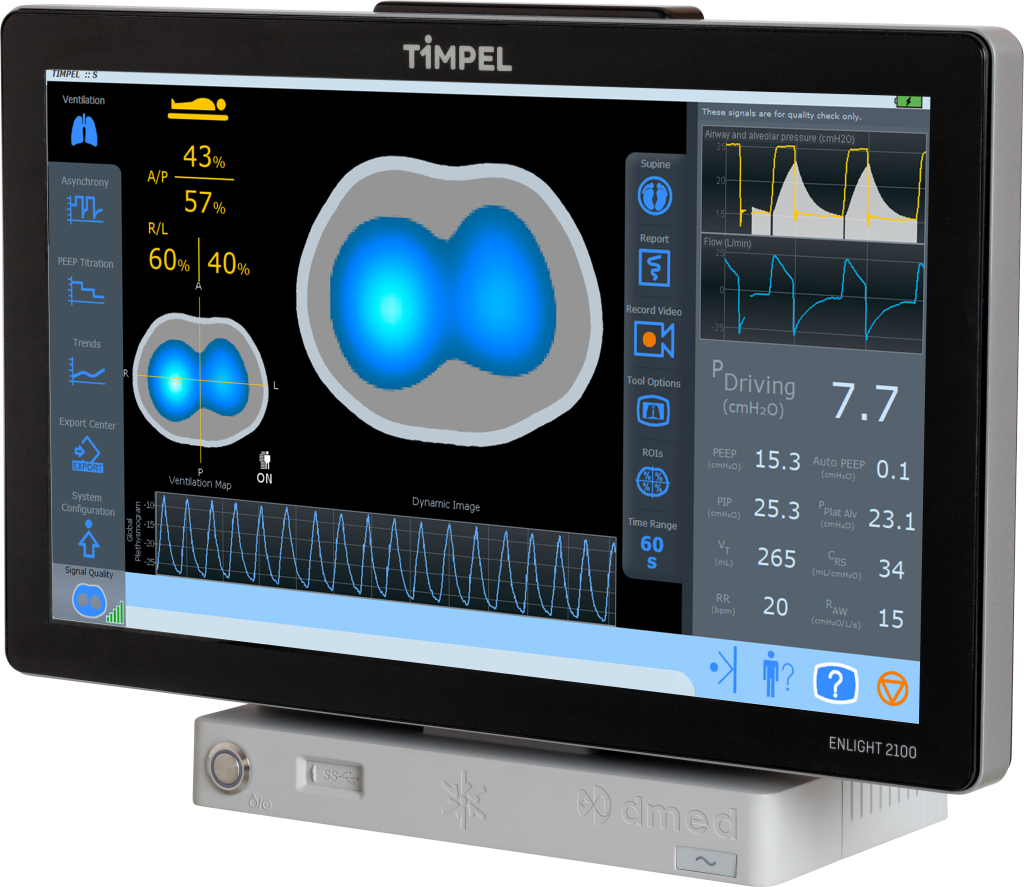
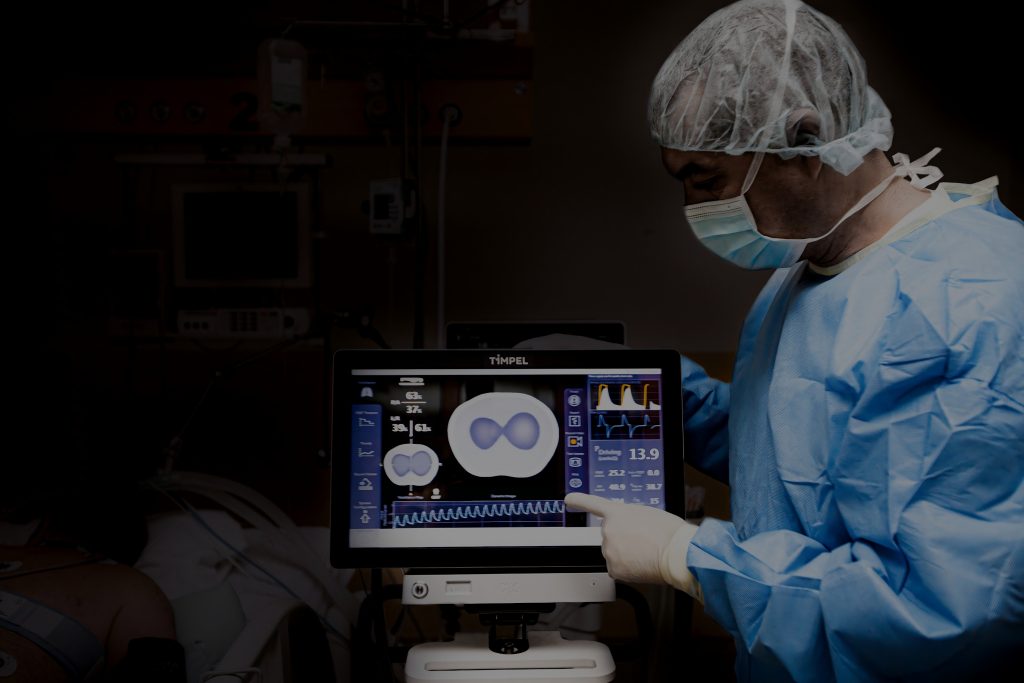
Enlight 2100 ENLIGHT 2100 is a bedside Electrical Impedance Tomograph (EIT) that provides clear, real-time and intuitive images of the regional distribution of ventilation of neonatal, pediatric and adult patients, allowing the assessment of regional lung volume changes.
ENLIGHT applies a harmless electrical current through an electrode belt placed around the patient´s thorax, allowing the visualization of:
- Asynchronies and asymmetries with the percentage of ventilation distribution, unveiling the patient´s lungs heterogeneities and unique physiological responses to mechanical ventilation;
- The behavior of Tidal Variation and End Expiratory Lung Impedance in different Regions of Interest;
- Airway Pressure, Flow and Volume curves and pulmonary mechanics parameters side by side withV entilation Map and Dynamic Image;
- EIT data displayed according to patient´s positioning, with instantaneous visual feedback of each patient’s response to ventilation;
- Asynchronies, such as Double Trigger and Reverse Trigger, and the Breath-Stacking volume in mL/Kg;
- PEEP Titration Tool, with automatic detection of PEEP changes and real time calculation of compliance, regional and accumulated hyperdistension and collapse, in PCV and VCV modes;
- Trends data from up to 48 hours, being possible to analyze and compare moments and better understand patient´s individual response to the treatment.
The electrodes are built into the electrode belts, leading to a very thin and flat surface. They are easy to apply, requires only a slight lateral tilt in patient’s positioning. Adult/Pediatric belts are covered with Addere, a breathable cover that has an embedded gel, allowing a gentle contact and use for up to 48 hours, with no need for extra contact agents. The Neonatal belt has a layer of breathable gel embedded, allowing a safe and gentle contact to the skin. ENLIGHT has its own Flow Sensor, therefore can be used in connection with all ventilators.
Technical characteristic
I. Configuration (basic)
- Main unit ENLIGHT 2100.
- AC cable.
- Electrode belts and cables (variety size).
- Adderer (variety size).
- Reference cable.
- Neonatal belt adapter.
- Flow sensor (2 types, Adu/Ped and Neo).
- Shaper (2 sizes).
II. Product characteristics
1. Main features
- Can be used for patients from neonates, pediatrics, and adults.
- Continuous monitoring of real-time lung dynamic tomography.
- Uses low amperage current for measurement, non-radiative, non-invasive.
- The electrode parallel measurement mechanism improves spatial accuracy and resolution.
- Animation resolution 32×32, frame rate 50Hz.
- Electrode contact test screen: 5 signal levels, EMG, ECG noise detection and filtering, etc.
- Many types of monitors: lung ventilation, expansion, trend, regional air distribution, layer distribution, and quadrant distribution.
- Allow import, export, read, and saved data via USB.
- There is a research mode for doctors who conduct research with EIT.
- Support many file formats when exporting: Video, PDF report.
2. Details
MANY TOOLS TO SUPPORT PERSONALIZED PATIENT CARE
1-Ventilation monitoring tool:
- Impedance variation waveform ∆Z (plethysmogram).
- Dynamic tomography, real-time, 50frame/second.
- Lung air distribution chart (ROIs: total, regional, layers).
2-PEEP titration tool (PEEP titration tool):
- Used with descending PEEP detection.
- Automatic reminder to reduce PEEP periodically.
- Monitoring and statistics of 3 parameters: inflation, expansion, atelectasis.
- Visualize PEEP detection results in 3 formats: shape, table, graph.
3-Trend analysis tools (Trends):
- Supports 6 layouts and 14 parameter groups.
- Compliance change comparison tool.
- Gas distribution change comparison tool.
- Bookmark events. Supports 3 quick bookmark buttons and many custom bookmarks.
- Zoom in, zoom out the graphs.
- Maximum tracking time to the nearest 48h.
4-Report export tool (Export Center):
- Support export PDF report for all screens, functions, tools.
- Record and output ventilation screen video, duration 30s.
- Manage output files by patient to avoid confusion.
- System management tool (System configuration screen).
- Adjust, check in-depth on signal acquisition and processing.
- Check operating information of the system (voltage, current, machine temperature,…).
- View the user manual directly on the machine.
- Advanced settings for technicians.
5-(option) Ventilator asynchronous monitoring tool (Asynchrony Tool):
- Two types of screens: real-time and summary.
- Generate reports for each display screen.
- Monitor real-time monitoring: 30s, 60s and 120s.
- Monitor statistics for 1 to 6 hours.
- Tracking parameters: Double Trigger, Reverse Trigger, Breath Stacking, Breath Stacking Volume, Normal Vt, Asynchory Index (AI).
- AI asynchronous stats update every 2 minutes as %.
II. Technical information
- All-in-one PC, compact and versatile
- Weight: <12.5 kg (<38 kg with Trolley)
- Main machine dimensions:< 350 x 470 x 150 mm
- Main power Nominal voltage: 100 – 240V (automatic CB). AC power frequency: 50/60Hz
- Maximum power consumption during operation 60W
- Normal power consumption, during operation 45W
- Battery backup 30 minutes
- Maximum current consumption of 0.6A at 100V; 0.3A max at 230V
- Frame rate (time resolution) 50 real frames per second
- Power supply frequency 125kHz
- 5-inch medical grade color screen, 1366×768 pixels, multi-touch.
- Allows screen sharing to the network via the Ethernet port.
- Data connection port: USB, Ethernet.
III. Monitoring parameters:
1. Ventilation screen
- Vt (ml): The tidal volume.
- Pdriving (cmH2O): Driving pressure.
- PIP (cmH2O): Peak inspiratory pressure.
- PplatAlv (cmH2O): Maximum alveolar pressure at the end of inspiration (equal to Paw if Tpause ≤0.5 s)
- PEEP (cmH2O): Positive end-expiratory pressure.
- AutoPEEP (cmH2O): Endogenous PEEP. By the difference between the measured PEEP and the set PEEP
- RR (bpm): Respiratory rate in 1 minute.
- CRS (mL/cmH2O): Expansion of the respiratory system. It has an approximate value of static expansion.
- RAW(cmH2O/L/s): Airway Obstruction.
2. PEEP titration tool screen
- PEEP (cmH2O): Positive end-expiratory pressure.
- Hyperdistension (%): % of over inflated lungs.
- Collapse (%): % collapsed lung.
- Compliance (ml/cmH2O): Pulmonary compliance.
- Countdown time (s): count down the time between PEEP lowering.
- Step (cmH2O): PEEP lowering detection threshold per step down.
- A/P Ratio (%): Anterior/posterior ventilation ratio.
- R/L Ratio (%): Right/left ventilation ratio.
3. Trends screen
- Global Plethysmogram: electrical impedance variation of the whole lung.
- Regional Plethysmogram (different ROIs): Variation of impedace according to region of interest.
- Global Tidal Variation Z: Variation of air circulation by impedace Z.
- Regional Tidal Variation Z (different ROIs): variation of airflow by Z by region.
- Global EELZ: The global EELZ index.
- Regional EELZ (different ROIs): EELZ index by region of interest.
- Peak Pressure: Peak pressure.
- Alveolar Plateau: End-inspiratory peak alveolar pressure (plateau pressure)
- PEEP: Positive end-expiratory pressure.
- Driving Pressure: Driving pressure.
- Compliance of the Respiratory System: The compliance of the respiratory system (lungs and thorax).
- Airway Resistance: The degree of resistance to the airway.
- Compliance Z: Variation of impedace by area
- Respiratory Rate: Respiratory rate.
- Respiratory Rate z: Respiratory rate in signal from EIT.
- Tidal Volume: The volume of circulating air.
- A/P Ratio: The ratio of ventilation of Anterior/Posterior.
- R/L Ratio: The ratio of ventilation of Right/Left.
- Double Trigger: double triggering of breath.
- Reverse Trigger: reversed trigger.
- Breath-Stacking: Breathe stacking.
- Asynchrony Index: Asynchronous Index.
4. (Option) Asynchory Tool screen
- Double Trigger (DT, %): double triggering of breath.
- Reverse Trigger (RT, %): reversed trigger.
- Breath- Stacking (B-S, %): Breathe stacking.
- Breath-Stacking Volume (mL/kg): The volume of air that is over-breathed.
- VT normal cycle (mL/kg): The tidal volume of a normal rhythm.
- Asynchrony Index (AI, %): Asynchronous index.

